TECHNOLOGY
Meet the AI Platform Redesigning mRNA Delivery
Toronto's LUMI-lab screened 1,700+ lipid nanoparticles autonomously, finding a new class of mRNA delivery boosters that outperform COVID vaccines
10 Jun 2026
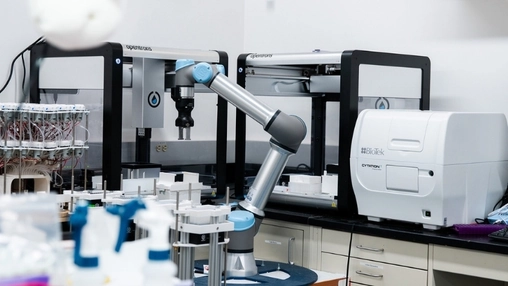
Only three lipid nanoparticles have ever earned FDA approval as drug-delivery vehicles. Given that mRNA medicines depend almost entirely on these tiny fat capsules to reach their targets inside cells, that number is surprisingly small. A team at the University of Toronto thinks automation can change the arithmetic.
Their platform, called LUMI-lab, pairs machine-learning algorithms with robotic synthesis to hunt for better delivery vehicles without waiting for human instruction at each step. Pretrained on more than 28 million molecular structures, it ran ten consecutive learning cycles and tested over 1,700 candidate particles. Each batch of results fed directly back into the model, sharpening its next set of predictions.
The most striking finding was not one the researchers had anticipated. LUMI-lab flagged brominated lipid tails as a structural feature linked to stronger mRNA delivery into human lung cells, outperforming the lipids used in approved COVID-19 vaccines. No researcher had primed the system to look there. Safety profiles for the new lipids were comparable to established clinical standards, which matters for any path toward human use.
Conventional drug discovery tends to work by testing variations on what is already known. Closed-loop platforms like LUMI-lab work differently: predictions drive experiments, and experiments reshape predictions. Published in Cell, the study argues this cycle can produce genuine chemical insight rather than simple volume testing.
For the mRNA field, a larger set of viable delivery vehicles would matter well beyond infectious disease. Oncology and rare genetic conditions both depend on getting the right molecule into the right tissue, and selectivity has long been a limiting factor. The Toronto team plans to extend the platform to optimise for tolerability and tissue targeting at the same time, addressing a part of the design problem that has largely resisted brute-force approaches.
Whether LUMI-lab's brominated candidates reach clinical testing remains to be seen. What the platform has already demonstrated is that the most useful discoveries may be the ones no one thought to specify in advance.
Related News


SUBSCRIBE FOR UPDATES
By submitting, you agree to receive email communications from the event organizers, including upcoming promotions and discounted tickets, news, and access to related events.